The Best Music Charities to Support
Some music charities pay a musician's rent after a stroke. Others put a trumpet in a nine-year-old's hands. Here's how to pick the one that fits your gift.
 Reading Time 9 mins
Music charities do different jobs. The most direct good music can do is reach someone who can't get to a concert anymore: a hospice patient, a veteran in a VA hospital, a grandmother in memory care. That's the job we do, and it's why we lead this list. Other charities pay a working musician's rent after surgery, or put instruments and teachers into schools that lost their music programs. Decide which of those you want your money to do, and the choice gets easy.
Giving doesn't have to mean writing a check, either. Hosting a private benefit concert in your own backyard raises money and puts live music in front of your neighbors.
Full disclosure: Harmony & Healing publishes this list, and we're on it. Our entry sticks to the same kind of facts as everyone else's: what a gift pays for and where to check our numbers.
Here are eleven music charities and what each one pays for
| Charity | Who it helps | What a gift pays for |
|---|---|---|
| Harmony & Healing | Hospice and hospital patients and their families | Live musical visits, at no charge to patients |
| MusiCares | Music professionals in the US | Emergency money, addiction recovery, disaster relief |
| Musicians Foundation | Professional musicians in the US | Grants paid straight to a musician's bills |
| Sweet Relief Musicians Fund | Career musicians and music industry workers | Help with bills during illness, disability or old age |
| Jazz Foundation of America | Jazz and blues musicians | Housing help, pro bono medical care, paid school gigs |
| Help Musicians | Professional musicians in the UK | Health, wellbeing and career support |
| Save The Music Foundation | Public school students | Instruments and equipment for school music programs |
| Hungry for Music | Kids and teachers without instruments | Donated instruments |
| The Roots of Music | New Orleans kids, ages 9 to 14 | Marching band training, meals, transportation |
| Girls Rock Camp Alliance | Youth rock camps worldwide | Resources and community for member camps |
| Women in Music | Women working in the music business | Education, mentorship, chapters |
Harmony & Healing brings live music to patients
Harmony & Healing

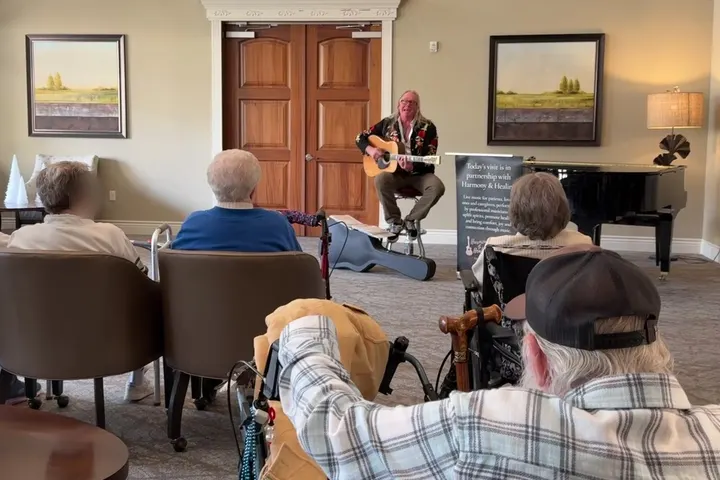
A Harmony & Healing visit in a care community garden
Our professional musicians perform live musical "visits" for hospice and hospital patients of all ages. Harmony & Healing is a 501(c)(3) based in San Ramon, California, founded by David Victor, the former guitarist and co-lead vocalist of the multi-platinum band BOSTON. Yes, that BOSTON. In our own words, the mission is "to bring patients, loved ones and caregivers solace and soothing, heartfelt live music that resonates in their souls, and gives them hope for tomorrow."
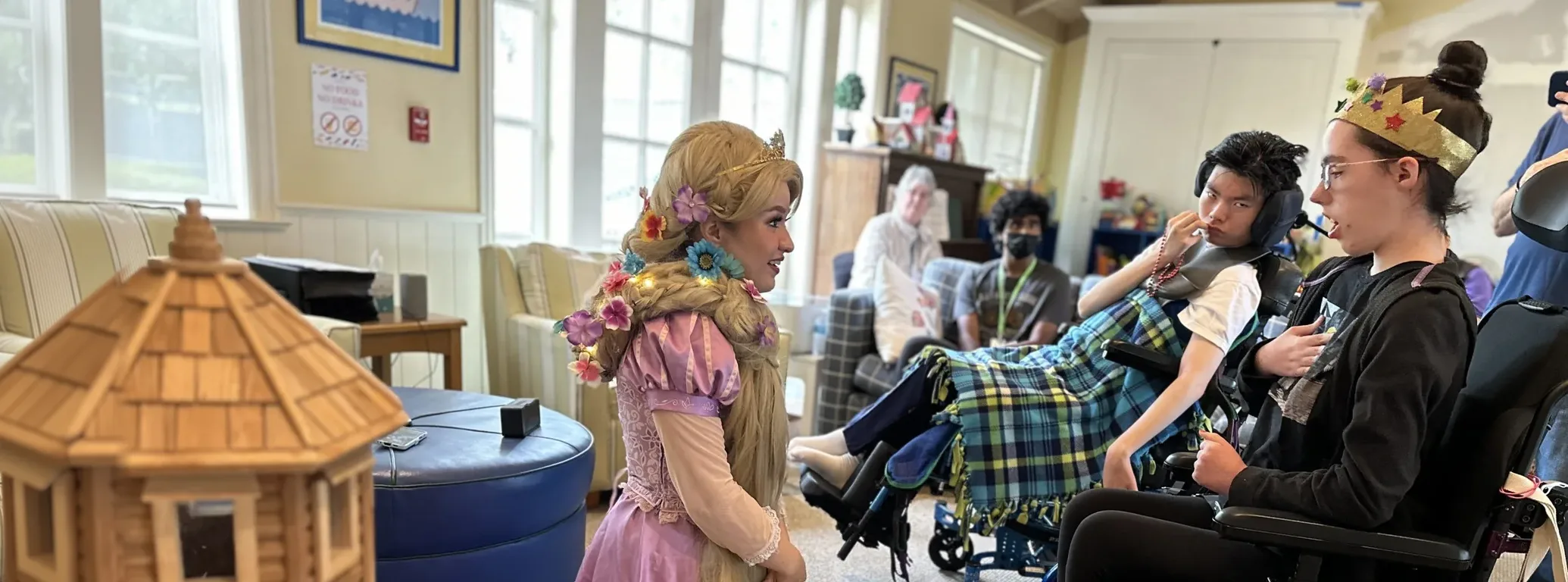
Here's what a gift does. When you donate to Harmony & Healing, the money pays a professional musician to play for patients in hospice, hospitals, memory care, VA and rehab facilities around the San Francisco Bay Area, with some visits by Zoom. Visits are always at no charge to patients and their families. Facilities book regular monthly or bi-monthly visits, and we schedule special visits near the end of life. The places we visit include the Martinez VA and George Mark Children's House, a pediatric hospice in San Leandro.
Your gift does two jobs at once. The musicians aren't volunteers. We pay them for every visit, so the same donation that brings music to a hospice day room is paid, meaningful work for a professional musician. For a lot of musicians, steady paid work is the thing that keeps a hard month from turning into a crisis.
It isn't music therapy, and we don't claim it is. Music therapists are licensed clinicians. Ours are working musicians who play the songs that mattered most in their listeners' lives.
We're small, and the numbers are public. Our 2025 Form 990-EZ shows $59,409 in revenue, all of it contributions, and $50,041 in expenses (ProPublica). We hold Candid's 2026 Gold Seal of Transparency. Run a facility that would like visits? Request a musical visit here.
These charities help musicians through illness, debt and disaster
Plenty of working musicians have no employer health plan, no paid sick leave and no steady paycheck. One broken wrist or one cancelled tour can wipe out a year. Paid work, like the visits above, helps keep musicians out of crisis. These five charities step in after.

MusiCares supports musicians in times of financial, personal or medical crisis
MusiCares
The Recording Academy, the organization behind the Grammys, founded MusiCares in 1989 as an independent 501(c)(3). Think of it as music's safety net. MusiCares reports $146.4 million in financial assistance since 1989, including $32.5 million for mental health and addiction recovery and $44.3 million for disaster relief.
Look at the programs. They read like a list of everything that can go wrong in a music career. It runs free medical and dental clinics, pays bills during a crisis, and took over the Musicians Assistance Program in 2004 to help music people recover from alcohol and drug addiction. Its Safe Harbor Rooms, first set up backstage at the Grammy Awards in 1997, give artists in recovery a sober space at big music events. During COVID it paid out $35.7 million in emergency assistance between March 2020 and July 2022.
If you've ever wondered which charity famous musicians back, this is the obvious answer. Its Person of the Year gala has honored artists since David Crosby in 1991.
Musicians Foundation
Musicians Foundation has been doing one thing since 1914: giving professional musicians money when they need it. It calls itself the country's oldest independent nonprofit dedicated to financial help for musicians and their families. Grant checks go straight to the biller, so the landlord or the hospital gets paid and the musician keeps their dignity. No middleman, no awkwardness.
Sweet Relief Musicians Fund
Sweet Relief casts a wider net. Its help goes to career musicians and music industry workers, the sound engineers and road crew too, who are struggling to make ends meet while facing physical or mental health issues, disability or age-related problems. It runs a toll-free assistance line, which tells you how direct the help is meant to be.
Jazz Foundation of America
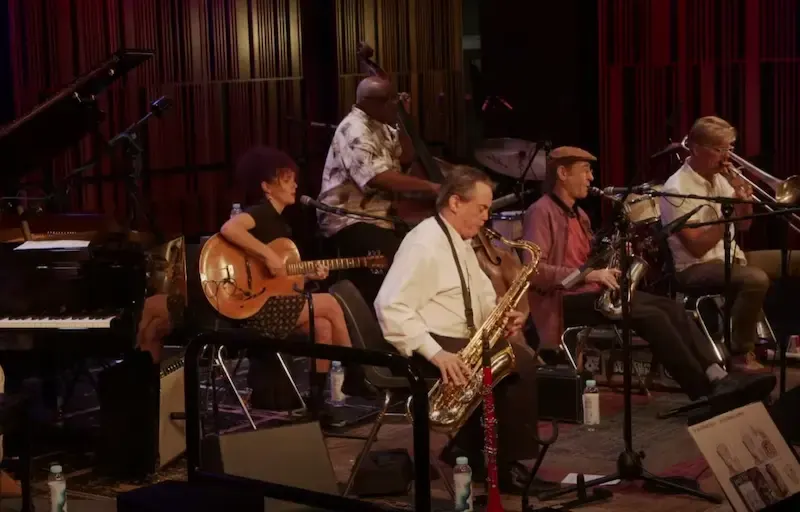
The Jazz Foundation of America looks after the elders of jazz and blues. Its Musician's Emergency Fund provides housing assistance, pro bono medical care, hurricane disaster relief and financial support to musicians and their families.
The clever part is the second program. Jazz and Blues in the Schools hires musicians who can't tour anymore to play for public school kids who have no music program, in 17 states. One donation does two jobs: a paid gig for an older musician and live jazz for a classroom.
Help Musicians (UK)
Giving from Britain? Help Musicians is the working name of the Musicians Benevolent Fund, an independent UK charity that's supported professional musicians of every genre for over 100 years, both in work and in retirement. US donors should know that a gift to a UK charity usually isn't tax-deductible on an American return.
These charities keep music in schools and in kids' hands
Public school music lives and dies by the budget. These four charities rebuild it from different angles: equipment, instruments, after-school programs and summer camps.
Save The Music Foundation (formerly VH1 Save The Music)
If you're looking for the best music charity for school programs, start here. MTV executive John Sykes started Save The Music in 1997 after a day as principal of a Brooklyn school whose music program was at risk. For most of its life it was VH1 Save The Music. In 2025 it became fully independent of Paramount Global, which is why you'll now see it under the shorter name. Same charity.
It gives grants for instruments and equipment to public schools and has partnered with school districts in 42 states, Puerto Rico and Washington, DC. It says it has helped more than 2,800 schools. That's a lot of band rooms. Since 2017 a Music Tech grant has also paid for high school programs in beat making, recording and audio production.
Hungry for Music
Hungry for Music keeps it simple. It gets instruments to kids who want to play and can't afford to. A Washington, DC area 501(c)(3) since 1994, it has placed more than 27,000 instruments with aspiring musicians, 3,116 of them in 2025 alone. You can give money, or donate the guitar in your closet. Teachers and social workers can request instruments for their students.
The Roots of Music
Derrick Tabb, a Grammy winner and CNN Hero, created The Roots of Music in New Orleans in 2007, in the aftermath of Hurricane Katrina. It started small. Six weeks of drum camp at Tipitina's, the music club. Its flagship Marching Crusaders band serves kids ages 9 to 14 from low-income households, and it feeds them hot meals and drives them both ways so nothing keeps a kid from showing up. Young adults who want to go pro can continue in the Roots Academy.
Girls Rock Camp Alliance
The Girls Rock Camp Alliance is an international membership network of youth-centered arts and social justice organizations. In plain terms, it's the hub for the rock camps where kids learn an instrument, form a band and play a show by the end of the week. A gift supports the network. To fund a camp directly, look up the nearest member camp on its site.
This charity opens doors for women in the music business
Women in Music

Women in Music has worked since 1985 to advance women in the musical arts through education, support, empowerment and recognition. It's a 501(c)(3) with 25 chapters around the world, from LA to Japan. Members aren't all performers. They range from students to label executives, engineers, attorneys and touring musicians. Membership dues and donations fund the mentoring, networking and education that keep women in the industry once they get there.
How can you tell a music charity is legit?
Four free checks take about ten minutes, and they work on any charity, including us.
- Confirm the tax status. The IRS Tax Exempt Organization Search shows whether a charity is a 501(c)(3), which is what makes a US gift tax-deductible.
- Read the 990. ProPublica Nonprofit Explorer posts every charity's annual IRS filing for free: revenue, expenses, and what the top people are paid. One catch: organizations with gross receipts under $50,000 can file a 990-N postcard, which has no financial details.
- Look for a Candid profile. Candid (formerly GuideStar) gives Seals of Transparency to charities that share their programs, leadership and finances. Here's ours.
- Check the rating. Charity Navigator rates charities on finances and accountability. It doesn't score every small charity, so a missing rating isn't a red flag by itself.
Giving in California? The Attorney General's Registry of Charitable Trusts lists every charity registered to raise money in the state. Ours is here.
Then ask the question that matters most. What exactly does my gift pay for? A good charity answers in one sentence, the way MusiCares answers with dollars and Hungry for Music answers with instruments.
What do music charity programs actually achieve?
Look for the outputs a charity is willing to count in public. MusiCares counts dollars paid out. Save The Music counts schools and districts. Hungry for Music counts instruments. The Roots of Music counts the kids in its band who get fed and driven home.
Programs that serve patients count differently, because nobody should hand a survey to someone in hospice. The honest measures there are how many visits happen, how many facilities take part, and whether those facilities keep booking visits month after month. Be wary of any music charity, ours included, that promises a medical result. Live music creates moments of connection. It doesn't cure disease.
You can support music charities without writing a check
- Donate an instrument. Hungry for Music takes the ones gathering dust.
- Throw a party with a purpose. A private benefit concert turns your living room or backyard into a fundraiser.
- Give in someone's memory. A tribute gift to a music charity honors someone who loved music.
- Name a charity in your will. Bequests and gifts from a donor-advised fund keep paying for music long after you're gone. Here's how a legacy gift works with us.
- Show up. Most of these organizations need volunteers, from camp counselors to homework helpers.
Supporting a Bay Area cause this year? Our guide to the best Bay Area charities to donate to covers food, housing and health along with music.
Table of Contents
- Here are eleven music charities and what each one pays for
- Harmony & Healing brings live music to patients
- These charities help musicians through illness, debt and disaster
- These charities keep music in schools and in kids' hands
- This charity opens doors for women in the music business
- How can you tell a music charity is legit?
- What do music charity programs actually achieve?
- You can support music charities without writing a check
- Donors & Supporters: Donate now & make an impact!
- Activities Directors: Get Regular Musical Visits for Your Facility Today!
Donors & Supporters: Donate now & make an impact!
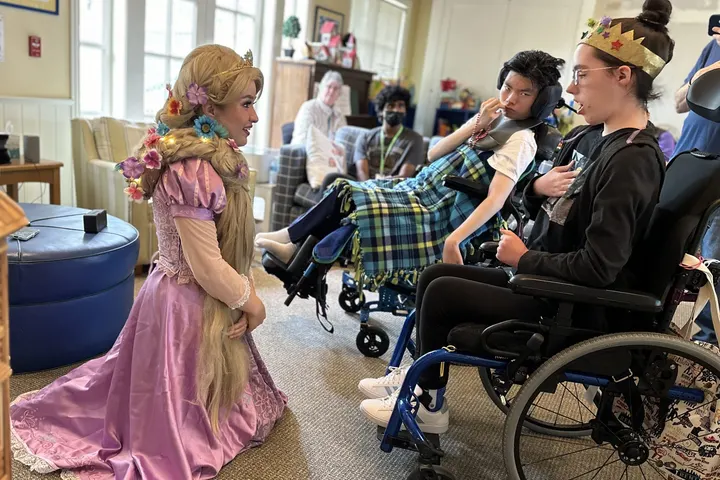
Help us bring soothing live music to hospital patients, families & loved ones.
Donate